
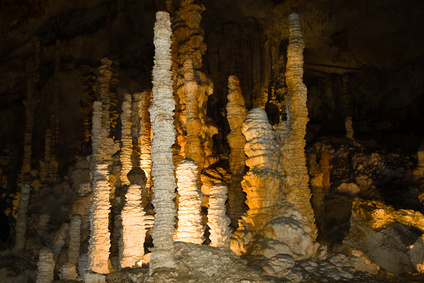
Near the village of Orgnac-l’Aven, it’s off into the underworld… The Aven d’Orgnac cave (www.orgnac.com/visite-grotte-ardeche.php) near the Ardèche awaits its visitors, cave tourists and speleologists. In 1935 the cave was discovered by a team of researchers exploring the area around the River Ardèche. The karst cave was first opened to the public in 1938 and has been considerably extended over the years by newly discovered parts of the cave. A real adventure awaits those who want to explore the European underground.
The Aven d’Orgnac cave (Ardèche, southern France)
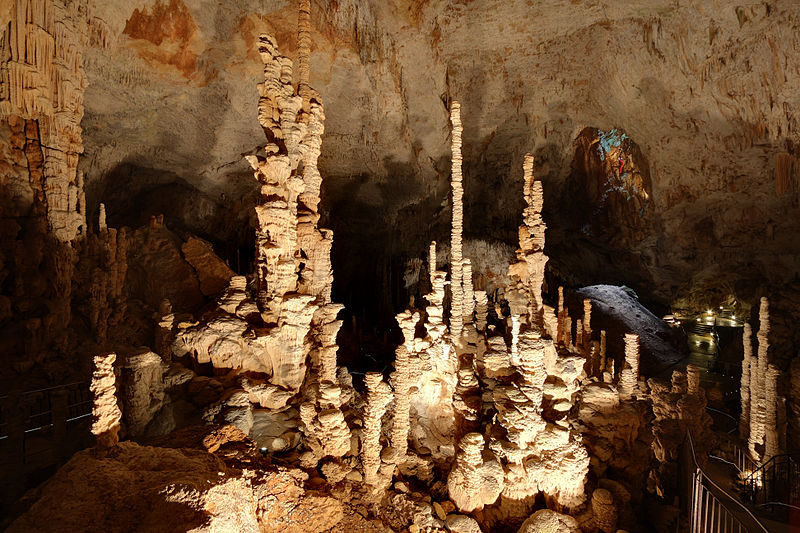
In the karst cave you first walk 121 metres down. Nature has created real crystalline masterpieces in the cave. Stalactites growing from the ceiling and stalagmites forming on the floor created a fairy-like world of candles, pillars, crystal organs, curtains, crystalline plates and palm-like growths lining the way down. On the descent of about 500 metres the visitor discovers lovely viewing platforms from which he is safely guided into the main cave, 121 metres deep. Once there, a special show awaits the cave tourist: a light and sound show (son et lumière) illustrates the wonders of nature in a very special way. The tour is accompanied by a dedicated guide, who also offers it in English, Dutch and German. After the one-hour tour you go back up to the surface by lift. A special feature for disabled people: the lift takes you down into the visitor cave.
Speleology excursions in the Aven d’Orgnac cave
For visitors interested in speleology, the French organisers offer three tours, which must be booked in advance. These are the tours “La Randonnée” (the hike), “L’Odyssée” (the odyssey) and “Le Vertige” (vertigo). Equipped with the necessary gear and accompanied by an experienced tour guide, the visitor experiences an extraordinary mineralogical variety. Various underground parts of the cave are visited and the areas developed for tourism, such as the main cave, are avoided. With the caving tours the visitor discovers the parts of the grotto that are not accessible to the normal cave tourist. About 300 metres of caving rope have been strung, along which visitors work their way. Only through these links are all parts of the cave passable. The tours are aimed at interested people who are sporty and already have a certain amount of experience, including technical experience.
The tour “La Randonnée”, for example, is designed for groups of up to eight people. The walk lasts about three hours. As technical equipment, the tour requires a caving helmet with a light, a caving suit and boots. And of course the camera should not be forgotten. The minimum age of group participants is twelve. Booked individually, this tour costs 39 euros per person, for group bookings 37 euros. Good physical condition is required here.
Sportspeople love the Odyssey
The tour “L’Odyssée” lasts a full eight hours for physically active people, since sometimes crawling is called for. The members of the group gain insights into the parts not open to the public and discover, for example, hidden “treasure chambers” and beautiful crystalline forms and sculptures. And on a tour lasting eight hours, food for the little breaks in between should also be packed. Towels for the shower after the tour are also recommended. The tour costs 64 euros per person, 59 euros for group bookings. The number of participants is limited to eight.
If the speleologists feel like following in the footsteps of the cave’s discoverer Robert de Joly, the tour “Le Vertige” is worthwhile. Climbing harnesses and lanyards are mandatory for this group of at most six participants, in addition to the normal explorer’s equipment. On this tour there is also crawling, climbing and abseiling at times. It is only suitable for sporty people over 14. The tour costs 43 euros per person, 41 euros for group bookings. The tour lasts a good three hours. And if the cave-exploring participants still feel like seeing what was discovered in the caves after the tours, a visit to the prehistoric museum is worthwhile. Here it becomes clear how our ancestors lived, which animals they hunted and how the groups were composed… and for sporty and non-sporty visitors alike there is a hall where a film shows how the Aven d’Orgnac karst cave was discovered grotto by grotto.
Photo credit: http://commons.wikimedia.org/wiki/File:Aven_Orgnac_salle_sup.jpeg