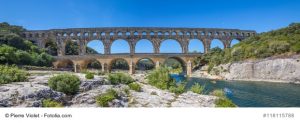
Pont du Gard, the fully preserved Roman aqueduct over the River Gard
Although the south of France is one of the most attractive regions of France for tourists, and is therefore one of the best developed provinces in the country, there are still wild corners off the beaten track that let you experience the south of France in a different way. One of them is the Languedoc. A small neighbour of Provence and the Côte d’Azur, the Languedoc stretches west of the Rhône and north-east of the Garonne, right on the Mediterranean. With its départements of Ardèche, Gard, Hérault, Aude and Tarn, the Languedoc has provinces of exceptional history, where there is much to discover both in nature and in culture. Continue reading “Wild southern France: hidden gems of the Languedoc”
Just 12 kilometres from the holiday home in Labastide-de-Virac, culture lovers can step back into the distant times of the European Old Stone Age: hyenas and panthers dart across the rock walls, the eyes of an owl flash in the half-light, and above several fleeing horses’ heads a rhinoceros raises its extraordinarily long horn. Anyone visiting the Chauvet cave finds themselves in a surreal animal world of African steppe and Central European forest dwellers. It is remarkable how faithfully our ancestors depicted the fauna of their time. Research into the cave drawings, discovered only in 1994, is in fact still in its infancy. One thing is already certain, however: these paintings are not only among the oldest in the world, but are also unique in their variety and artistic execution….
by Inocybe at fr.wikipedia [Public domain], from Wikimedia Commons“Twenty years ago a unique cave was discovered in the Ardèche valley: Stone Age people had decorated it with more than 1,000 drawings. Now an elaborate replica of the cave is opening.” (Source: Die Welt, 7 January 2015)
An interesting article about the Chauvet cave, for which a museum with a 1:1 replica will open in spring 2015, very close to the Ardèche, near Vallon-Pont-d’Arc.
“Just 12 kilometres from the holiday home in Labastide-de-Virac, culture lovers can step back into the distant times of the European Old Stone Age: hyenas and panthers dart across the rock walls, the eyes of an owl flash in the half-light, and above several fleeing horses’ heads a rhinoceros raises its extraordinarily long horn. Anyone visiting the Chauvet cave finds themselves in a surreal animal world of African steppe and Central European forest dwellers. It is remarkable how faithfully our ancestors depicted the fauna of their time. Research into the cave drawings, discovered only in 1994, is in fact still in its infancy. One thing is already certain, however: these paintings are not only among the oldest in the world, but are also unique in the world in their variety and artistic execution….”
[read more]
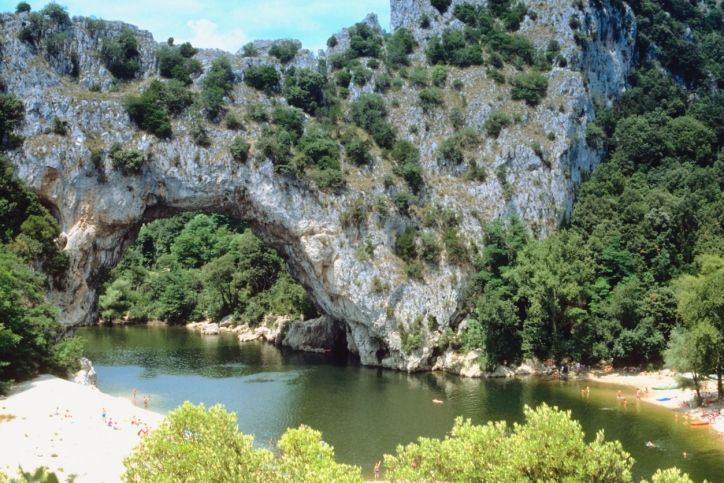
The Ardèche département owes its name to the famous river. But the region has much more to offer than canoe trips and the Pont d’Arc. The choice of routes is so large that motorcyclists are spoilt for choice.
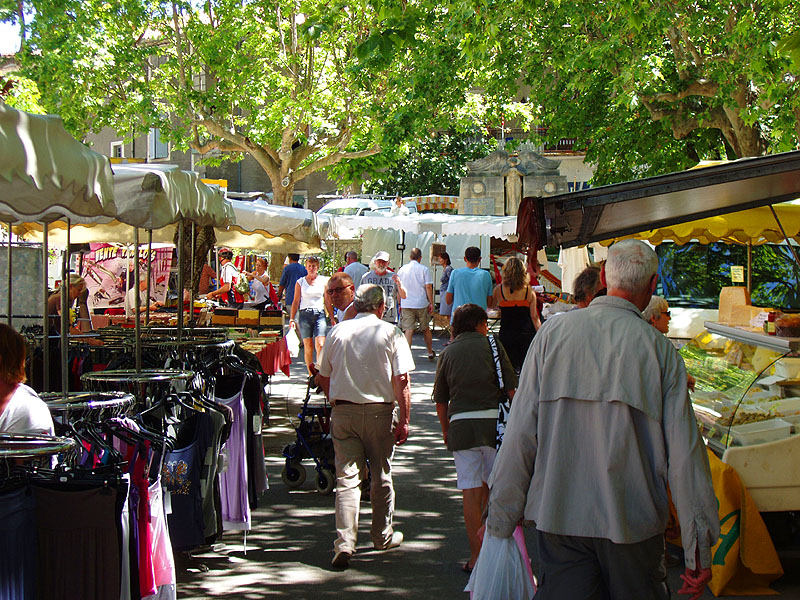
Brocante market in Barjac: Since 1972, probably the best-known flea and antiques market has been held every year at Easter and in mid-August in the old Renaissance town of Barjac. This year, too, more than 400 dealers will offer their antiques and well-preserved old pieces under the shady plane trees on the Place Charles Guynet. The Barjac market has enjoyed an excellent reputation for years. It therefore attracts collectors and flea market fans from France and all over the world.
The Chauvet Pont-d’Arc cave is not open to the public, but work on an exhibition project near Vallon Pont d’Arc is advancing (www.lagrottechauvetpontdarc.org). The original cave itself is estimated to date from 36,000 BC and has held, since its discovery in 1994, untold treasures of cave painting. In total, researchers have so far found 425 animal images whose uniqueness makes what was previously familiar look as if it were “already discovered”. The opening of a faithfully reproduced cave nearby will take place in 2013, in 2014 at the latest. Already more than 21,000 connoisseurs are working to have the original cave admitted to the UNESCO World Heritage list. Continue reading “Chauvet Cave at the Pont d’Arc: an original cave is “rebuilt” in style”
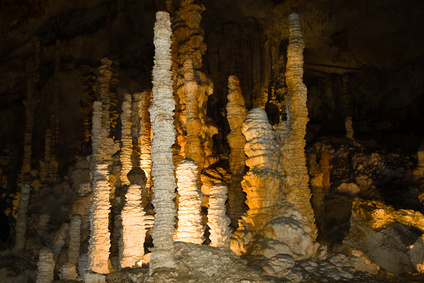
Near the village of Orgnac-l’Aven, it’s off into the underworld… The Aven d’Orgnac cave (www.orgnac.com/visite-grotte-ardeche.php) near the Ardèche awaits its visitors, cave tourists and speleologists. In 1935 the cave was discovered by a team of researchers exploring the area around the River Ardèche. The karst cave was first opened to the public in 1938 and has been considerably extended over the years by newly discovered parts of the cave. A real adventure awaits those who want to explore the European underground. Continue reading “Aven d’Orgnac: an exciting trip into the Ardèche underworld”
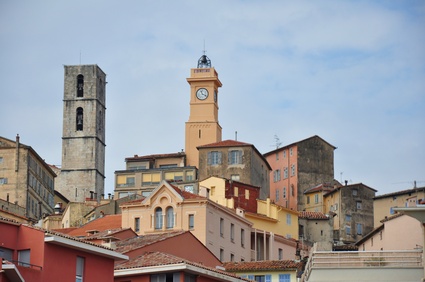
When people talk about Provence, most of them immediately picture large blue lavender fields. But Provence can look quite different too. There are also steep mountain slopes with narrow roads, where not a single lavender field can be seen for miles. This region belongs to the French Maritime Alps, and here lies the famous town of Grasse, about 20 kilometres north of Cannes.
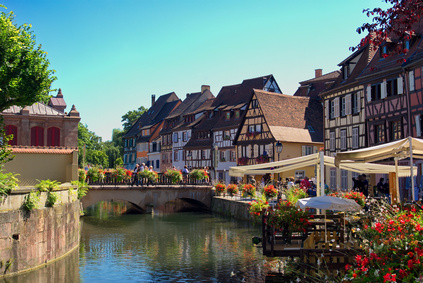
In the east of France lies Alsace. It borders Switzerland to the south, Franche-Comté to the west and the Federal Republic of Germany to the north and east. The Alsace region in its present form was only created in 1973. The administrative district has a chequered history behind it; sovereignty swung between Germany and France, so that the cultures of the two countries mixed strongly in the border region. Continue reading “Alsace – a region with charm”
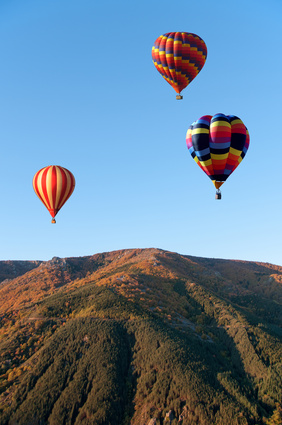
Montgolfière is the name of the first hot-air balloon, presented in 1783 by its inventors, the two Montgolfier brothers. Even today you can marvel at the brothers’ ideas and numerous interesting exhibits in the Canson & Montgolfier Paper Museum in Annonay.
Every year in June, by the way, the two brothers are commemorated in Annonay with an intoxicating festival with splendid costumes and countless colourful hot-air balloons. Anyone who can choose when to travel to the Ardèche should therefore visit the region in June.