
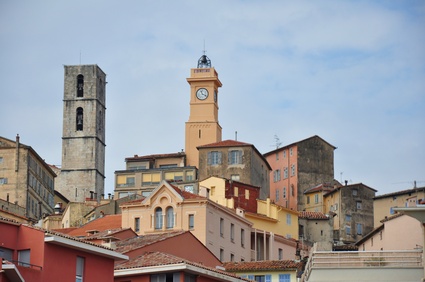
When people talk about Provence, most of them immediately picture large blue lavender fields. But Provence can look quite different too. There are also steep mountain slopes with narrow roads, where not a single lavender field can be seen for miles. This region belongs to the French Maritime Alps, and here lies the famous town of Grasse, about 20 kilometres north of Cannes.
Grasse, city of scents
At the latest since the film adaptation of Patrick Süskind’s novel “Perfume”, the town of Grasse has become known to a wide public. The town was first mentioned in documents as early as the 11th century. The craft of tanning was very widespread here. Around the year 1600 people began to perfume gloves. This masked the smell of badly tanned leather. Now the great era of Grasse began, with the distillation of fragrances. Characteristic flower plantations spread around the town.

Today they have become rare, since most of the flowers are imported from low-cost countries, such as Morocco, India, Bulgaria or Turkey. In addition, synthetic fragrances are increasingly used in perfume making. Even today there are about 30 perfume factories in Grasse that export their products all over the world. Some of them can be visited, and on a guided tour you can learn a lot about how perfume is made. The Fragonard perfume factory even has a museum attached. Here you can see a private collection of distillation flasks, flacons and other items documenting the history of perfume from antiquity to the present day. Taking part in a perfume workshop is also a special experience. Here you can create your own scent and then take it home. This also gives you a small insight into the work of a perfumer, who can recognise up to 3,000 scents. The “nose”, as a perfumer is also called, has to make some sacrifices for this, however: giving up alcohol, smoking and hot spices. These can considerably impair the sense of smell. In the whole world there are only about 1,000 such “noses”.
Perfume making yesterday and today

The distillation of essential oils by steam is one of the most important techniques in traditional perfume making. In enfleurage, by contrast, warm fat or oil is used to draw the fragrances out of the plant parts. For delicate flowers such as jasmine, the technique was developed further so that it was possible to work with cold oil. Heat would have destroyed the delicate flowers. These oils were suitable for further processing into ointments. By washing the filtered oil with alcohol, an alcoholic fragrance could be obtained that was suitable for making perfume.
Around the middle of the 19th century industrial perfume production developed. The development of synthetic fragrances made this possible. The first perfume on the market to contain these new substances was the famous Chanel N°5. It was, by the way, created in Grasse in 1925. Synthetic raw materials for producing a high-quality perfume are not necessarily cheaper than natural raw materials. But they offer constant quality and are also used for ecological reasons.