
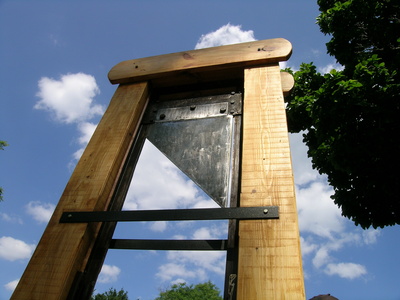
An inn that is as isolated as possible yet strategically well placed, preferably in the middle of dark forests, happily housed in old stone walls, frequented by shady customers and run by a hardly trustworthy pair of innkeepers, is one of the classic, popular settings, much used in European pulp literature, for criminal and mostly rather bloody goings-on. In the German-speaking world, Wilhelm Hauff’s tale of the inn in the Spessart from 1828 is probably the best-known robber story, in which unsuspecting travellers are murdered and robbed treacherously at night by murderous innkeepers and guesthouse proprietors; in France, by contrast, it is the “Auberge Rouge” (Red Inn), or L’Auberge de Peyrebeille, located in what is now the territory of the municipality of Lanarce, with its good 160 souls, in the canton of Coucouron in the arrondissement of Largentière, in the south-westernmost corner of the Ardèche, that enjoys this high degree of fame as a once fateful death trap for people passing through. Already then almost unavoidably situated on the economically immensely important trade route between the Rhône valley and the Auvergne, and between the nearest larger towns of Aubenas and Le Puy-en-Velay, the sprawling building was a stopover for many sometimes quite wealthy business travellers; of these, no fewer than 53 were to bitterly regret their stay there between 1805 and 1830, since they did not survive it. Whether it received its gruesome name because of these more than four dozen robbery-murders proven in court, or because of the execution by guillotine, said to have been watched by 30,000 spectators, of the culprits found guilty at the time, Pierre Martin, Marie Martin and Jean Rochette, in the courtyard of the inn on 2 October 1833, can no longer be settled beyond doubt today.
Once treacherous home cooking, where the chestnut trees still bloom
Visitors to the eerie inn can now of course explore it, as well as the surrounding area marked by steep rock walls, wooded hills, dense oak forests and numerous stalactite caves, entirely without danger; in the rooms of the former crime scene there is today an interesting, informative and well worth seeing museum about the bloody deeds, and right next to it you can dine and stay comfortably (and guaranteed safely) in a newly built, spacious and modern motel with a restaurant. The innkeeping couple Martin and their accomplice Rochette are said to have looted the equivalent of almost 600,000 euros over a quarter of a century; according to witness statements, the victims’ remains were said not only to have fuelled the establishment’s bread oven but also to have ended up on the menu in the dining room, and according to the legal findings Madame Martin served for years very, very special pâtés and ragoûts; neighbours also repeatedly reported telltale kitchen waste and mysterious plumes of smoke. Today’s holidaymakers in this southern part of the Ardèche, regarded as the regional granary, need no longer worry about such dubious ingredients, however; the area is known for its good wines and olives and fruit varieties, and hearty dishes are also prepared from the wild boar roaming the deciduous forests here in large numbers. Numerous dolmens and burial mounds dating from the time of Celtic settlement shape the landscape in many places, and there are also some Romanesque castle ruins to visit. A very popular excursion destination is also the imposing Gorges de l’Ardèche on the border with the Gard département with its beautiful scenic road; the 180,000-hectare “Parc naturel régional des Monts d’Ardèche”, founded in 2001 and characterised by chestnut forests, pastures, volcanic craters, maars, and granite, limestone and slate soils, offers golden eagles, marmots, wildcats and countless insect species a safe refuge.