
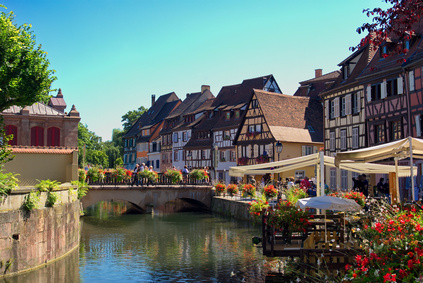
In the east of France lies Alsace. It borders Switzerland to the south, Franche-Comté to the west and the Federal Republic of Germany to the north and east. The Alsace region in its present form was only created in 1973. The administrative district has a chequered history behind it; sovereignty swung between Germany and France, so that the cultures of the two countries mixed strongly in the border region.
Strasbourg, Sélestat and Colmar – pearls of Alsace
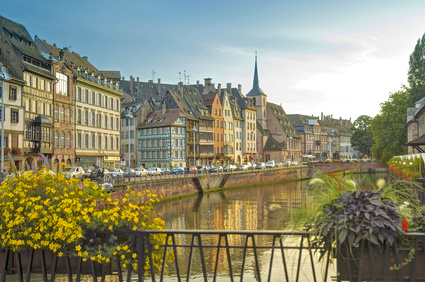
Strasbourg is probably one of the most beautiful cities in Europe. The area around Strasbourg Cathedral, the UNESCO-protected old town of Grande Île, is characterised by medieval half-timbered houses. The oldest secular building, the Maison Kammerzell, dates from 1427, the Romanesque and Gothic cathedral from the period 1176 to 1439. The houses of the Grande Île were built in the Alemannic South German style and have up to five storeys. Characteristic of the construction are the very steep roofs with up to four storeys. The medieval flair that Strasbourg’s old town exudes is so intense that probably no visitor would be surprised if Walter von Geroldseck, consecrated bishop in 1260, suddenly met him with his retinue on the way to the cathedral, or if the humanist Erasmus of Rotterdam (c. 1467 to 1536) came round the corner on horseback. Petite France with its half-timbered buildings and the tanners’ quarter on the Île also give a decidedly picturesque impression.
Sélestat comes across as decidedly charming, with its winding little lanes flanked by half-timbered houses. The pretty old town, whose history is closely linked with the Hohenstaufen, is UNESCO-protected. In 1087 Hildegard of Büren, great-grandmother of Barbarossa and widow of Frederick of Büren, founded a Holy Sepulchre chapel, which passed to Conques Abbey in 1094. The little town was subject to the priory until Frederick II granted it imperial city status in 1216. Also worth seeing, about ten kilometres away, is the Château du Haut-Kœnigsbourg, one of the most visited castles in all of France. From the impressive complex an incomparable panoramic view over the Rhine plain awaits the visitor.
Colmar bears the nickname Petite Venise because it is crossed by a labyrinth of picturesque narrow canals lined with medieval half-timbered houses. There are also numerous buildings in the Gothic and Renaissance styles, which impressively demonstrate the wealth of the past. Six centuries of architectural history can be admired in the town on the Alsace Wine Route. The Krutenau, a district along the River Lauch, is distinguished by particularly beautiful houses and bridges. Adjoining the Krutenau is the Quartier des Tanneurs, the former tanners’ quarter, with its likewise old-fashioned but much plainer appearance.
Full-bodied wines and charming villages
A wine route one hundred and seventy kilometres long runs through Alsace from south to north. The prettiest wine villages lie at the foot of the Vosges, where many of the imposing castles that are characteristic of Alsace stand. On thirty-eight wine hiking trails along the wine route, visitors can learn a lot about the tasty wines, and in the pretty villages winemakers and restaurants offer the local speciality. In Alsace mainly Sylvaner, Riesling, Muscat d’Alsace, Pinot Blanc and Pinot Gris, Gewürztraminer and the Pinot Noir are grown, the latter pressed into rosé and red wine. Under the name Crémant d’Alsace hides a dreamlike sparkling wine that is typical of the region.
A region for gourmets
Away from the tourist routes, gourmets also find their El Dorado in Alsace, with its hearty but tasty cuisine. Among the particular specialities is Alsatian sauerkraut, which is prepared with apple juice. Sauerbraten, too, goes not into a vinegar but into an apple juice marinade. A few restaurants offer Baeckeoffe, a stew of potatoes, leek and meat. The best-known speciality is probably the tarte flambée, a yeast dough with crème fraîche, bacon and onions that is reminiscent of the German onion tart. A real tarte flambée has a thin base, with bacon dominating the topping. Very popular as a side dish, both in Alsace and in the Ortenau, are the Grumbeerekiechle or galettes, small potato pancakes. Foie gras is duck or goose liver, served fried or as a pâté with Alsatian white wine. The sweet dishes of Alsace, especially the friands, sweet pastry pies, the Alsatian apple cake, the Zwatschgawaia, the plum cake, or the bredele, biscuits with plenty of cinnamon and nuts, are often served with coffee. A typical dessert is cheese, especially Alsatian winemaker’s cheese and Munster cheese, together with sweet dessert wine.
A paradise for nature lovers – Alsace
In Alsace there are two large nature parks, the Parc Régional des Ballons des Vosges in the Haut-Rhin and the Parc Régional des Vosges du Nord in the Bas-Rhin. The Parc Régional des Ballons des Vosges is an area of almost three thousand square kilometres that stretches from Alsace through Franche-Comté to Lorraine. Educational trails at Hohrod, at the Lac d’Urbès, at the Taennchel and in Gunsbach and at the Ballon d’Alsace lead through dreamlike nature and give information about the animals and plants native to the nature reserve. The Parc Régional des Vosges du Nord lies in the triangle of Saverne, Wissembourg and Volmunster, extended on the German side by the Palatinate Forest Nature Park. UNESCO has classified the park, with more than 65 percent forest cover, as a biosphere reserve, so that a large number of rare animals such as the wildcat and the peregrine falcon have a refuge there. In addition there are a number of smaller local nature reserves in Alsace such as the Petite Camargue on the Swiss border near Basel, the Forêt de Haguenau, the Illwald east of Sélestat or the Ried near Muttersholtz.
In the area around Strasbourg and deep into the Ortenau, storks live because of the relatively large food supply in the wet parts of the landscape and because of supplementary feeding, and some now even overwinter in the region. Almost every village has at least one stork’s nest, and in some places two or more stork families live. Together with the beautiful old half-timbered houses, it is a decidedly romantic sight. The Alsatians’ affinity for storks comes from the tale that the stork symbolises a child of love. The Gallic cockerel and the German eagle spent a passionate night of love from which the stork emerged. Storks are the unofficial heraldic animal of Alsace. In 1982 there were just two pairs of storks in the region. Since then almost four hundred pairs of storks live in Alsace again, but the population is not yet considered secure. In the Parc de la Cigogne, storks form a fascinating community with otters, sea lions and cormorants.
A short excursion into a long history
The first settlement of Alsace by humans dates back about seven hundred thousand years. From around 2000 BC there was presumably a political upper class. The presence of the Celts is established from around 600 BC. After Caesar’s conquest of Gaul between 58 and 52 BC, Alsace came under Roman rule for the next five hundred years as part of Upper Germany (Germania superior). After the Romans began to withdraw their troops around 406, Alsace was probably under Ostrogothic or Alemannic administration. From around 496 until the middle of the eighth century Alsace belonged to the Frankish Empire as the Duchy of Alemannia. At that time Strasbourg, made a bishop’s see in 614, as well as Speyer and Basel were assigned to Alsace.
Until the middle of the eighth century, the Duchy of Alsace existed after the Duchy of Alemannia as the domain of the Etichonids. There followed the Swabian Hohenstaufen, the Austrian Habsburgs, the Counts of Hanau-Lichtenberg, the House of Württemberg and the Rappoltsteins, until the French royal house gradually annexed Alsace from 1633. After the second Peace of Paris in 1815 small areas went to Bavaria and Landau, while the rest remained with France. As early as 1871 a part of Alsace experienced another change of ruler: it became German again and received, as Alsace-Lorraine, the status of an imperial territory. After the First World War the area was again under the French state, with the Alemannic dialect prevailing in Alsace and the Moselle Franconian dialect in German Lorraine. In 1940, during the Second World War, Alsace was German, until it finally fell to France in 1945. The official language in Alsace today is French, but the majority of “long-established” Alsatians still speak the Alemannic dialect; the younger generation, who no longer grow up with the dialect, receive German lessons at school.