
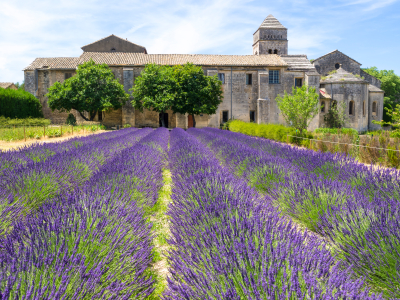
Winters in Paris are cold and grey, the damp climate weighs on the spirits and dulls the soul. This, or something like it, is how painters of every generation have experienced the hectic life of the French capital. What a blessing it was for them when they could escape the grey north to study the calm light and intense colours of the south of the country. In this way a very close interaction arose between the Mediterranean coast and the capital in the north. The painters needed intensive exchange with their colleagues in the cafés, galleries and museums of the big city in order to exchange ideas and be inspired. At the same time, none of the great artists of Impressionism or Expressionism could do without the sunny, shimmering colours of Provence. Here, in their retreats and studios, they soaked up the colours and the light, which they then transported to the north by means of their paintings.
Every visitor who reaches the French Mediterranean coast will experience a similar effect. Blue sky, yellow sunflowers, blue lavender and the intense ochre of the earth tempt you to photograph and capture the colours. This experience is not new, of course. A journey along the coast from Toulouse to Nice can be turned into a voyage of discovery into modern painting.
Pioneer of open-air painting
One of the first painters to capture the atmosphere of the south in his pictures was the French painter Pierre-Henri de Valenciennes. He was born around 1750 in Toulouse in the Languedoc and was one of the most important landscape painters of his time. He studied painting at the Royal Academy of Toulouse (Académie royale de Toulouse) and undertook extensive journeys through southern France. His pictures are regarded as precursors of the mood painting of Romanticism and Impressionism. Valenciennes was one of the first to go out into the country with his easel and make open-air painting respectable.
The painting of the south is much older than you think
In the valley of the Ardèche there are many large caves that have been inhabited by people since time immemorial. The discovery of their paintings exerted a great influence on the development of Expressionism. In 1878 the Chabot cave in the Ardèche département was discovered. The impressive wall paintings were created around 22,000 to 18,000 BC. The sweeping forms and intense colouring of the painted animals were studied and absorbed with enthusiasm by painters. Further caves were discovered in quick succession. Yet there are still very many caves that have not been found. One of the last caves to be discovered is the Chauvet cave, which was opened only in 1994. It is located near the small town of Vallon-Pont-d’Arc (Ardèche département) in the river valley of the Ardèche. It contains over 400 wall paintings with more than 470 painted and engraved depictions of animals and symbols. The oldest of them are estimated at over 30,000 years. The pictures make clear that the climate and the light already inspired people to paint and experiment back then.
Studio of the South
One of the most important towns for French painting is the town of Arles. The town’s most famous resident is Vincent Willem van Gogh. His style of painting had a formative influence on the Fauves and Expressionists. Van Gogh lived in great poverty, yet he left more than 864 paintings, a large part of which were made in Arles and the surrounding area. He moved to Arles in 1888 to escape the northern winter and to find here the “blue tones and cheerful colours” of the south. His landscapes were initially born of necessity, because he could not afford models. Today his pictures “Langlois Bridge” or the series of blossoming orchards are an indispensable part of art history. A journey in the footsteps of van Gogh also leads to Saintes-Maries-de-la-Mer and Saint-Rémy-de-Provence, where he likewise found inspiration for famous pictures. Van Gogh had a dream. He wished for a studio of the south in which many artists would live and work together. The only artist he could win over for this experiment was Paul Gauguin, who actually stayed in Arles for a few months to be inspired by the colours of the south.
In November 1901 Paul Cézanne bought a small property outside Aix-en-Provence to set up a studio there. Today the little house lies within the town and can be visited as the Atelier Cézanne. In the small house the famous artist painted some of his pictures, including “The Bathers”. The museum has a very interesting exhibition concept. With the help of his easel, paint pots, work clothes and objects he used as motifs for his still lifes, an attempt is made to recreate the artist’s working atmosphere.
South for his health
Amedeo Modigliani, too, was enchanted by the blue tones and cheerful colours of the south. The artist died in 1920. He was only 35: he had suffered all his life from a lung disease. He moved to Cagnes-sur-Mer in 1917, later directly to Nice, in order to be able to work better. The influence of southern France, with its harsh contrasts of light and shadow, can be traced exactly in Modigliani’s work. After his stay in Nice he painted pictures with clearly outlined structures and colourful, clearly delimited areas. While Modigliani lived in Nice, he kept close contact with Pierre-Auguste Renoir, who lived on a large estate above the coast in the neighbourhood. Renoir, too, had moved from Paris to the warm, dry south because of the climate. The estate “Les Collettes”, where Renoir lived from 1907, is now open to visitors as a museum.
A castle for the uncrowned king of painting
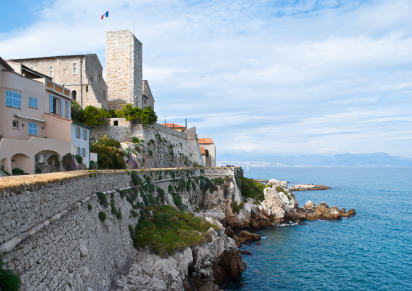
The uncrowned king of all southern French painters is Pablo Picasso, who spent his late years in Antibes and Nice. Picasso in turn kept in contact with Henri Matisse, who also stayed here. An important museum dealing with Picasso’s life is the Picasso Museum in Antibes. Here visitors can admire paintings as well as ceramics and sculptures by the great master. Picasso bought the Château de Vauvenargues near Aix-en-Provence. From here he had a wonderful view of Paul Cézanne’s favourite motif, the Montagne Sainte-Victoire. He spent his twilight years with Jacqueline Roque in Mougins, north above the slopes of Cannes, where he died on 8 April 1973. He was buried in the garden of his château in Vauvenargues.