
Only 12 kilometres from the holiday home in Labastide-de-Virac , culture lovers can immerse themselves in the long-vanished times of the European Palaeolithic: hyenas and panthers flit across the rock walls, an owl’s eyes flash in the half-light, and above several fleeing horses’ heads a rhinoceros swings its overlong horn into the air. Anyone who visits the Chauvet Cave finds themselves in a surreal animal world of African steppe dwellers and Central European forest dwellers. It is remarkable with what fidelity to detail our ancestors depicted the fauna of their time. Research into the cave drawings, discovered only in 1994, is in fact still in its infancy. Even so, one thing is already certain: these cave paintings are not only among the oldest in the world but, in their variety and artistic execution, also unique in the world.
Cultural and historical significance of the Chauvet Cave

With long strides, a boy runs along the cave walls, leaving behind not only his footprints in the clayey floor but also black torch charcoal on the walls. The boy is on his way to a ritual initiation rite and probably has no idea that his footprints will one day become world famous. Around 30,000 years later, researchers and scientists search every square centimetre of the cave and find evidence of ritual practices. Our ancestors visited the 500-metre-long Chauvet Cave, which has four chambers, only sporadically; yet they documented their visits with paintings on the rock walls. These were mainly predators, which could certainly be dangerous to humans but were by no means depicted as vicious, threatening or aggressive in the wall paintings. Rather, natural predators gather in harmonious unity on rock ledges, in niches and on steep walls. Also remarkable are the successful drawn depictions of movement, which achieve an impressive plasticity by doubling the outlines of the bodies.
The visitor centre of the Caverne du Pont-d’Arc
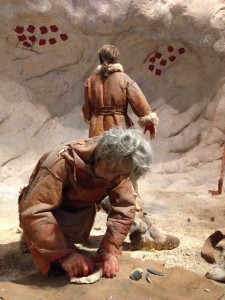
Only three kilometres from the original, the Caverne du Pont-d’Arc was built as a 1:1 scale replica of the Chauvet Cave. On a true-to-original pre-formed synthetic resin wall of 8,180 square metres, artists reproduced the wall paintings of the Chauvet Cave using natural colour pigments and charcoal, applying Palaeolithic painting techniques. In this way they ensured that the proportions, colour shades and arrangement of the animal images match the original. Thanks to this ultramodern reproduction, the cultural and historical treasure of the Chauvet Cave has been accessible to anyone interested since April 2015, while the original is preserved in the natural protection of the karst cave. Only researchers and scientists are allowed to enter the Chauvet Cave for a few weeks in spring and autumn. This regulation is intended to keep the humidity of the air at the same level and to prevent the rock paintings from being attacked by a fungus.
Getting there and visiting the show cave Caverne du Pont-d’Arc
From the holiday home in Labastide-de-Virac it is only a 20-minute drive to the Caverne du Pont-d’Arc visitor centre. The shortest route leads via Salavas and Vallon Pont d’Arc and on along the D4 to the visitor centre on the Plateau du Razal (GPS: N 44° 24′ 22.4676″ – E 4° 25′ 53.76″). The car can be parked free of charge in a large car park. As the Caverne du Pont-d’Arc can only be entered as part of a guided tour, booking tickets is advisable. On the website http://de.cavernedupontdarc.fr/ admission tickets can be pre-booked easily and securely by date and time of the tour. In addition to the cave visit, a Stone Age experience centre with exhibitions, workshops and animations, a restaurant with a viewing terrace and a souvenir shop invite you to visit.
Guest author: Daniela Fehrenbacher